
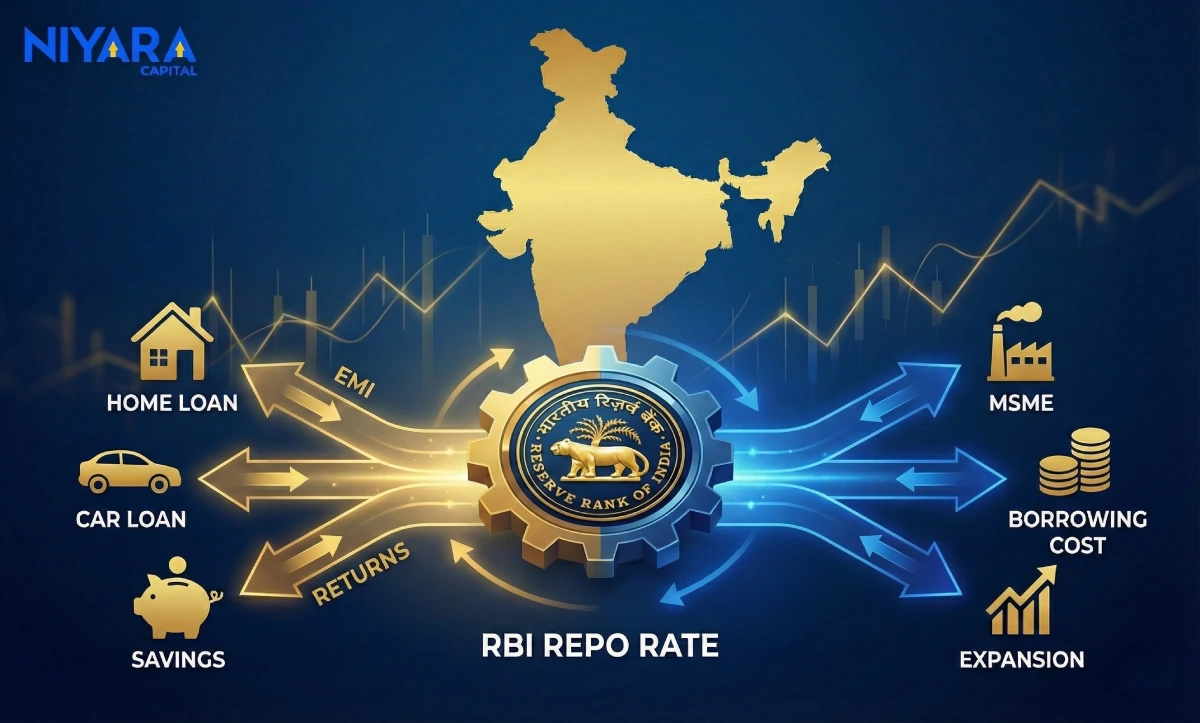
his blog post explains the Reserve Bank of India (RBI) repo rate, its function as a monetary policy tool, its historical context, and its direct impact on personal finances and businesses, particularly Micro, Small, and Medium Enterprises (MSMEs).
Understanding the intricate dance of India’s monetary policy.
The Repo Rate: A Key Economic Lever
- The repo rate is a crucial tool used by the RBI to manage the economy by influencing borrowing costs, savings returns, and business growth.
- It directly affects the price of borrowing money and the returns on savings, impacting individuals and businesses, especially India’s MSME sector.
Decoding the Repo Rate
The repo rate is the interest rate at which commercial banks borrow money from the RBI.
“Repo” stands for “repurchase agreement,” where banks sell government securities to the RBI with an agreement to buy them back later at a slightly higher price.
The difference between the selling and repurchase price constitutes the interest paid, which is the repo rate.
Example:
A bank borrowing ₹100 crore overnight from the RBI might repurchase securities for ₹105.25 crore, with the 5.25 crore difference representing the repo rate (5.25% in this example).
The RBI uses the repo rate to achieve its core objectives: controlling inflation, managing money supply, and stimulating economic growth.
Historical Context of the Repo Rate
The repo rate became a formal policy tool in the early 2000s as India’s economy matured. It has been used reactively to economic conditions:
- Mid-2000s: Raised to curb inflation and cool down an overheating economy during rapid growth.
- 2008 Global Financial Crisis: Cut to inject liquidity and encourage lending, preventing a severe downturn.
- 2020 COVID-19 Pandemic: Plummeted to all-time lows to support businesses and individuals.
- 2022-23: Increased due to rising inflation.
- As of December 2025: The RBI has begun easing monetary policy, lowering the repo rate to 5.25%, reflecting cautious optimism about inflation control and a need to support economic momentum.
Impact of Repo Rate Changes on Wallets and Businesses
The “transmission mechanism” describes how RBI rate decisions affect individuals and businesses. Loans linked to external benchmarks (EBLR) react faster to repo rate changes than older MCLR-linked loans.
For Individuals:
Loans (Home, Car, Personal):
- Rate Increase: Higher borrowing costs for banks lead to higher interest rates and EMIs for borrowers. A 0.25% increase on a ₹50 lakh home loan can raise monthly EMIs by over ₹800.
- Rate Decrease: Lower EMIs and more affordable borrowing.
Savings (Fixed Deposits, Savings Accounts):
- Rate Increase: Better returns on FDs and savings accounts.
- Rate Decrease: Lower returns, potentially prompting a search for higher-yield investments.
For Micro and Small Enterprises (MSMEs):
Cost of Borrowing:
- Rate Increase: More expensive business loans, working capital, and equipment finance, impacting profitability and growth plans.
- Rate Decrease: Cheaper credit facilitates access to funds for expansion, R&D, and operations.
Loan Linkage:
Over 67% of MSME loans are now linked to the repo rate, amplifying the impact of changes.
Cash Flow & Investment:
Lower borrowing costs improve liquidity and capital availability for investments, supporting initiatives like ‘Make in India’.
Debates, Dilemmas, and Expert Views
The RBI’s Monetary Policy Committee (MPC) engages in debates regarding policy decisions. The recent 25 bps cut was unanimous, indicating a consensus for a more accommodative policy.
Debates exist on the “policy stance” (neutral vs. accommodative).
- Some members advocate for an accommodative stance due to high real interest rates.
- Others prefer a neutral stance for flexibility.
RBI Governor’s View: Optimistic about robust growth and contained inflation (“Goldilocks” scenario).
Current Challenges & Headwinds:
- Lower FD returns negatively impact savers, especially senior citizens.
- Global uncertainties (geopolitical tensions, commodity prices) complicate decision-making.
- Questions about the “incremental impact” of further rate cuts on economic growth.
Future Outlook for the Repo Rate (2026 and Beyond)
The next MPC meeting is scheduled for April, 2026.
Influencing Factors:
- Benign inflation outlook.
- Revised GDP forecasts.
- Upcoming CPI and GDP base year revisions (February 2026), which may lead to a more “data-dependent” stance.
Conclusion: Staying Informed and Proactive
- The repo rate significantly impacts individuals and MSMEs.
- Understanding repo rate changes is essential for informed financial decisions.
- Niyara Capital aims to support MSMEs with credit solutions to navigate economic shifts.
- Staying informed and proactive is key to leveraging the repo rate’s influence for financial goals.